I’ve been reading through Luca Trevisan’s blog posts about relaxations of the Sparsest Cut problem. He discusses three relaxations: (i) spectral relaxation; (ii) Leighton-Rao and (iii) Arora-Rao-Vazirani. (i) and (iii) are semi-definite programs (SDP), which is an incredibly beautiful and useful generalization of Linear Programs. This technique is the core of the famous MAX-CUT algorithm from Goemans and Williamson and was also applied to design approximation algorithms for a large variety of combinatorial problems. As for Linear Programming, there is a Duality Theorem that allows us to give certificates to lower and upper bounds. I was curious to learn more about it and my friend Ashwin suggested me those great lecture notes by Lazlo Lovasz about semi-definite programming. I was surprised that the proof of the duality theorem for SDP is almost the same as for LP, just changing a few steps. We begin by using the Convex Separation Theorem to derive a Semi-definite version of Farkas’ Lemma. We use this version of Farkas’ Lemma to prove the Duality Theorem in a similar manner that is normally done for LP. Let’s go through the proof, but first, let’s define positive semidefinite matrices:
Definition 1 A matrix  is said to be positive semidefinite (denoted by
  ) if for all
  we have
  .
.
It is the same as saying that all eigenvalues of are non-negative, since the smallest eigenvalue of is given by  . We denote
  when all eigenvalues of are stricly positive. It is the same as
  for all
  . Also, given two matrices and
  we use the following notation:
  what is nothing more than the dot-product when we see those matrices as vectors in
  . Therefore:
Definition 2 A semi-definite program (SDP) is an optimization problem where the variable is a matrix  and has the form:
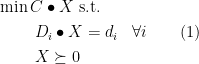
that is, it is a linear program and the restriction that the variable, viewed as a matrix, must be positive semi-definite.
The interesting thing is to use that the set  of semi-definite matrices is a convex cone, i.e., if
  then
then  for any
  . It is easy to see this is a convex set. Now we use the following theorem to prove Farkas’ Lemma:
Theorem 3 (convex separation) Given two convex sets  such that
  then there is
  such that
  for all
  and
and  for all
  . Besides, if one of them is a cone, it holds with
  .
.
Theorem 4 (Semi-definite Farkas’ Lemma) Exacly one of the following problems has a solution:
-
 ,
, 
-
 , …,
, …,  ,
, 
Proof: If problem  doesn’t have a solution then the cone
  is disjoint from the convex cone
  and therefore they can be separated. This means that there is
  ( plays the role of
  in the convex separation theorem), such that:
  for all
  and
and  for all
  . Now, taking
  and all others
  and then later
  and all other zero, we can easily prove that
  .
.
It remains to prove that . Just take  for and then we have that
  for all and therefore, .
Now, we can use this to prove the duality theorem. We will use a slighly different version of Farkas’ Lemma together with an elementary result in Linear Algebra. The following version comes from applying the last theorem to the matrices:

instead of  .
.
Theorem 5 (Semi-definite Farkas’ Lemma: Inomogeneous Version) Exacly one of the following problems has a solution:
-
 ,
,
- , …, ,
 ,
,
where  means
means  . Now, an elementary Linear Algebra result before we can proceed to the proof of the duality theorem:
Theorem 6 Given two semi-definite matrices and we have  , where
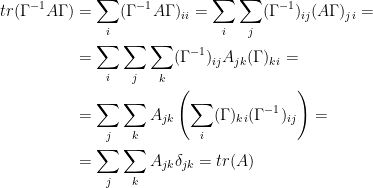
Proof: The trace of a matrix is invariant under change of basis, i.e. for any non-singular matrix  , we have that
  . This is very easy to see, since:
Now, we can write in the basis of ‘s eigenvectors. Let be a matrix s.t.  where
where  Now:
Now:

since  because the matrix is positive semi-definite and:

Now, we are ready for the Duality Theorem:
Theorem 7 (SDP Duality) The dual of the program 1 is given by:

We call 1 the primal problem and 2 the dual. If is feasible for 1 and  is feasible for 2, then
  . Besides, if the dual has a strict feasible solution (i.e. with
  ) then the dual optimum is attained and both have the the same optimal value.
As we can see in the theorem above, the main difference between this duality theorem and the duality theorem of linear programming is this “stictly feasible” condition in the theorem. Let’s proceed to the proof. As in the the LP proof the outline is the following: first we prove weak duality ( for feasible  ) and then we consider the dual restrictions with
  and we apply Farkas’ Lemma:
Proof: Weak duality: If is feasible for 1 and is feasible for 2 then:

because  and the
  of two positive semi-definite matrices is non-negative. Now:

by 1. Therefore, 
Strong duality: Clearly, the following problem has no solution:


where  is the optimal value of 2. Now we apply the inomogeneous Farkas’ Lemma to:

and we get a matrix  such that:

which means:  and
and  . We know that
  and
and  . We just need to prove that
  . We already know it is not negative, so we need to prove it is not zero and here we will need the hypothesis that the dual has a strict solution. If
  then there would be solution to:

and by Farkas’ Lemma, the problem:

would have no solution and we know it does have a solution. Therefore, .
Everything else comes from combining the weak and strong version described above.


![\displaystyle \mathop{\mathbb E}[k(\omega)] = \sum_{\omega \in \Omega} k(\omega) p(\omega)](http://s0.wp.com/latex.php?latex=%5Cdisplaystyle+%5Cmathop%7B%5Cmathbb+E%7D%5Bk%28%5Comega%29%5D+%3D+%5Csum_%7B%5Comega+%5Cin+%5COmega%7D+k%28%5Comega%29+p%28%5Comega%29+&bg=T&fg=000000&s=0 "\displaystyle \mathop{\mathbb E}[k(\omega)] = \sum_{\omega \in \Omega} k(\omega) p(\omega)")
![{\mathop{\mathbb E}[k(\omega)] \geq H}](http://s0.wp.com/latex.php?latex=%7B%5Cmathop%7B%5Cmathbb+E%7D%5Bk%28%5Comega%29%5D+%5Cgeq+H%7D&bg=T&fg=000000&s=0 "{\mathop{\mathbb E}[k(\omega)] \geq H}")


.





![{p(\omega) \in (0,1]}](http://s0.wp.com/latex.php?latex=%7Bp%28%5Comega%29+%5Cin+%280%2C1%5D%7D&bg=T&fg=000000&s=0 "{p(\omega) \in (0,1]}")


![\displaystyle \mathop{\mathbb E}[k(\omega)] = \sum_\omega k(\omega) p(\omega) \leq \sum_\omega [1 - \log_2 p(\omega)] p(\omega) = H + 1](http://s0.wp.com/latex.php?latex=%5Cdisplaystyle+%5Cmathop%7B%5Cmathbb+E%7D%5Bk%28%5Comega%29%5D+%3D+%5Csum_%5Comega+k%28%5Comega%29+p%28%5Comega%29+%5Cleq+%5Csum_%5Comega+%5B1+-+%5Clog_2+p%28%5Comega%29%5D+p%28%5Comega%29+%3D+H+%2B+1&bg=T&fg=000000&s=0 "\displaystyle \mathop{\mathbb E}[k(\omega)] = \sum_\omega k(\omega) p(\omega) \leq \sum_\omega [1 - \log_2 p(\omega)] p(\omega) = H + 1")




![{kH \leq \mathop{\mathbb E}[l(\omega)] \leq kH + 1}](http://s0.wp.com/latex.php?latex=%7BkH+%5Cleq+%5Cmathop%7B%5Cmathbb+E%7D%5Bl%28%5Comega%29%5D+%5Cleq+kH+%2B+1%7D&bg=T&fg=000000&s=0 "{kH \leq \mathop{\mathbb E}[l(\omega)] \leq kH + 1}")
![{\mathop{\mathbb E}[l(\omega)/k]}](http://s0.wp.com/latex.php?latex=%7B%5Cmathop%7B%5Cmathbb+E%7D%5Bl%28%5Comega%29%2Fk%5D%7D&bg=T&fg=000000&s=0 "{\mathop{\mathbb E}[l(\omega)/k]}")
![\displaystyle H \leq \mathop{\mathbb E}\left[\frac{l(\omega)}{k}\right] \leq H + \frac{1}{k}](http://s0.wp.com/latex.php?latex=%5Cdisplaystyle+H+%5Cleq+%5Cmathop%7B%5Cmathbb+E%7D%5Cleft%5B%5Cfrac%7Bl%28%5Comega%29%7D%7Bk%7D%5Cright%5D+%5Cleq+H+%2B+%5Cfrac%7B1%7D%7Bk%7D&bg=T&fg=000000&s=0 "\displaystyle H \leq \mathop{\mathbb E}\left[\frac{l(\omega)}{k}\right] \leq H + \frac{1}{k}")